
The remuneration of a cooperative leader is not comparable to that of a CAC 40 CEO. Dominique Schelcher, president of Coopérative U since 2018, receives an annual salary of 300,000 euros, a figure that places him far below the standards observed among major publicly traded retailers. This figure, made public by Capital, raises a broader question: how is the remuneration of a leader elected by independent merchants determined?
Cooperative status and remuneration: why Coopérative U operates differently
Coopérative U is not a publicly traded company. The group comprises over 1,700 stores and about 73,000 employees, but its governance is based on a simple principle: the members, independent merchants, elect their president and approve his remuneration.
This structure changes everything. At Carrefour or other publicly traded retailers, the CEO’s remuneration is included in a public reference document, detailing fixed, variable, and performance shares. At Coopérative U, there is no legal obligation to publish these details, as the group is exempt from the transparency rules imposed on listed companies.
The president’s salary is therefore negotiated internally, among peers. The members who vote are themselves business owners, proprietors of their stores. They make decisions based on what they consider fair for someone who remains, by statute, a merchant among others. Those who want to know how much Dominique Schelcher, head of Super U, earns must keep this framework in mind: the cooperative logic inherently limits remuneration.
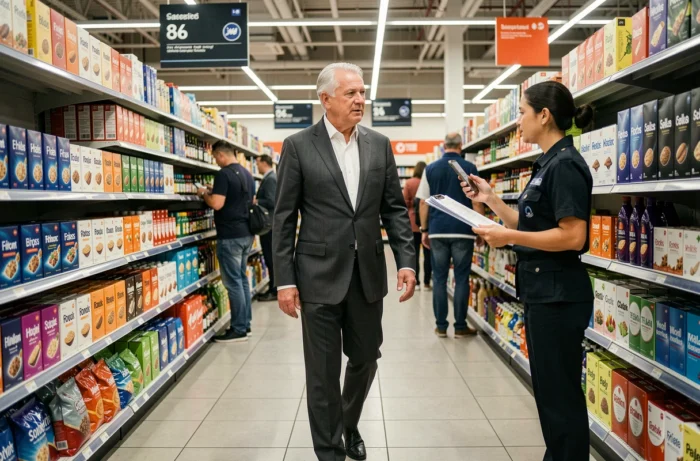
Dominique Schelcher’s salary compared to CEOs of major retailers
Dominique Schelcher’s annual salary of 300,000 euros is about 14 times less than Alexandre Bompard’s remuneration at Carrefour. The gap is not due to a difference in skills, but to a difference in economic models.
In a listed group, the variable portion (annual bonus, free shares, stock options) often constitutes the majority of the total remuneration of the leader. The remuneration of listed CEOs is measured in millions of euros per year, with a strong linkage to stock performance and operational results.
At Coopérative U, there are neither listed shares nor stock options. The president derives his income from two distinct sources:
- His salary as president of the group, set at 300,000 euros according to Capital.
- The results of his own Super U in Fessenheim, which he continues to manage in parallel. With a net margin of about 1.5% on an estimated turnover of 25 million euros, potential dividends remain modest. Schelcher claims to reinvest everything in his store.
This dual status (national president and local merchant) is typical of the cooperative model. It anchors the leader in the operational reality of his members, but mechanically caps his income compared to the major leaders in the sector.
Dominique Schelcher’s journey: from family Super U to presidency
Born on April 11, 1971, in Colmar, Dominique Schelcher graduated from Essca (École supérieure des sciences commerciales d’Angers) in 1993. His first career had nothing to do with large retail: he worked as a marketing and sales manager at Journal des enfants, within the L’Alsace group, from 1994 to 1997.
The turning point came in 1998 when he joined the family Super U in Fessenheim. He took over its management in 2004. From 2009, he took on national responsibilities by leading the purchasing center Système U Est and becoming a board member of the group.
Vice president in 2017, he succeeded Serge Papin as president in May 2018. Re-elected unanimously in June 2024 for a new term, he leads a distributor with a turnover of 34 billion euros. His book, “Le bonheur est dans l’action,” published in 2025, details his vision of management.
An atypical profile in the landscape of French retailers
Most leaders in large retail in France have held executive positions in large groups before reaching the top. Schelcher took the opposite route: he started from the family grocery store. This upward trajectory within the cooperative network partly explains his stance on purchasing power and food prices.

Salary transparency in large retail: what the Système U case reveals
The debate on remuneration in food retail is not limited to leaders. The gap between the remuneration of bosses and that of store employees is a recurring topic, amplified by negotiations on the purchasing power of consumers and producers.
In listed groups, this gap is documented and sometimes spectacular. In a cooperative like U, any media exposure of the leader’s salary creates a paradox: governance is more democratic, but financial information remains less accessible.
Three elements distinguish the remuneration policy at Coopérative U:
- The president does not have a variable remuneration linked to stock prices, which eliminates windfall effects related to financial markets.
- Each member votes on governance and, by extension, on the remuneration envelope for management. Control is exercised by independent merchants, not by institutional investors.
- Margins in food retail remain structurally low. Fruits, vegetables, and fresh products generate narrow margins, which weighs on the entire chain, from producer to distributor.
Dominique Schelcher himself summarizes the situation with a phrase: “We are far from the CAC 40 here.” The cooperative model limits remuneration disparities without guaranteeing total transparency. The question of whether this framework better protects the interests of producers, consumers, and employees than the shareholder model remains open and largely depends on the internal decisions specific to each group.