
The cadastral address of a property and its postal address refer to two distinct administrative realities, managed by different databases. The divergence between these two addresses affects a growing number of property owners, especially since the 3DS law of February 21, 2022, requires municipalities to name each street and number each building, including in rural areas. This discrepancy between references creates concrete difficulties in terms of taxation, real estate transactions, and mail delivery.
National Address Database and cadastre: two references, two logics
The confusion arises from a simple fact: the postal address and the cadastral address are not maintained by the same organization. The postal address falls under the National Address Database (BAN), jointly managed by the ANCT, DINUM, La Poste, and IGN. The cadastre, on the other hand, is under the General Directorate of Public Finances (DGFiP) and is primarily used for the fiscal and land identification of parcels.
A municipality can therefore change a street name or assign a new number in the BAN without the cadastre being updated at the same pace. This structural dissociation explains why property owners sometimes discover, during a sale or a tax declaration, that their property has a different address depending on the document consulted.
Understanding what happens when the cadastral address differs from the postal address allows for quick identification of which reference to correct as a priority.
| Criterion | Postal Address (BAN) | Cadastral Address (DGFiP) |
|---|---|---|
| Managing Organization | ANCT, DINUM, La Poste, IGN | General Directorate of Public Finances |
| Main Function | Mail delivery, geolocation, e-administration | Fiscal and land identification of parcels |
| Common Users | Postal operators, GPS, internet service providers, online public services | Notaries, tax services, surveyors |
| Update | Via municipal tools (“My Addresses”), rapid feedback | Update cycle specific to the DGFiP, often slower |
| Legal Value for Ownership | None (indicative) | Indicative (only the boundary survey is authoritative) |
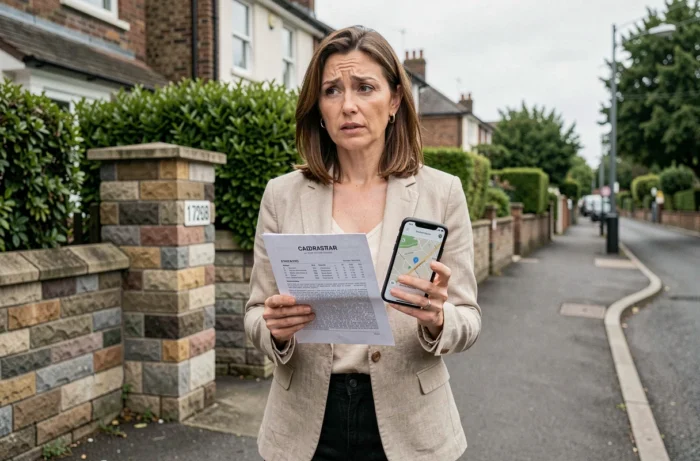
3DS Law and Municipal Addressing: why discrepancies have multiplied since 2022
Before the 3DS law, many rural municipalities operated with unnamed locations. The obligation to name each street and number each building triggered a wave of address creations and modifications across the territory.
The problem is that these new postal addresses feed into the BAN but are not automatically reflected in the cadastral databases. The discrepancy can last several months, sometimes even years, depending on the responsiveness of the local cadastre service.
For a property owner, this translates into concrete situations:
- The tax notice mentions an address different from that used by La Poste, complicating online tax procedures.
- A sales deed may mention an outdated cadastral address while the buyer knows the property by its new postal address, causing delays at the notary’s office.
- Emergency services or deliveries use the BAN, while land documents refer to a sometimes imprecise cadastral location.
Correcting the Cadastral Address: Steps with the Cadastre Service
Correcting an address discrepancy does not follow the same process depending on whether it is a simple clerical error or an official change of addressing by the municipality.
Report a clerical error to the cadastre
If the cadastral address contains a typing error (reversed number, truncated street name), the owner can directly contact the land publicity service or the property tax center to which the property belongs. The request can be made by mail or via the secure messaging service on the impots.gouv.fr website, attaching proof (tax notice, title deed, certificate from the town hall).
The cadastre has an indicative value, not a legal proof value. However, correction remains necessary to avoid inconsistencies in tax and notarial documents.
Aligning the cadastre after a municipal addressing change
When the municipality has renamed a street or assigned new numbers under the 3DS law, the town hall normally transmits the changes to the DGFiP. In practice, this information transfer is neither instantaneous nor systematic.
The owner should check the status of their parcel on cadastre.gouv.fr and, if the address has not been updated, submit a written request to the property tax center, attaching the municipal order for the name change of the street.
Impact on Real Estate Transactions and Local Taxation
A discrepancy between the cadastre and the BAN does not legally prevent a sale, but it complicates it. The notary must verify the consistency between the deed of ownership, the cadastral plan, and the actual address of the property. Any inconsistency delays the signing and may raise concerns for the buyer.
From a tax perspective, the cadastral address determines the attachment of a parcel to a municipality, which conditions the calculation of property tax. A property located on the boundary of two municipalities may have a postal address in one and a cadastral identification in the other. This scenario, common in suburban areas, has direct consequences on the amount of local taxes since property tax rates vary significantly from one municipality to another.

For properties affected by this type of border situation, only the cadastral reference (section and parcel number) is authoritative for determining the municipality of fiscal attachment, regardless of the postal address used in daily life.
The discrepancy between cadastral address and postal address is less a bug than a structural consequence of the coexistence of two unsynchronized references. The key takeaway: it is always the cadastral reference (section, parcel number, municipality) that takes precedence for property and property tax matters, while the postal address serves only for operational localization. Verifying both before any transaction remains the only reliable precaution.