Designing a house in Madagascar raises a question rarely addressed in traditional decor guides: how to make use of abundant local materials (raffia, sisal, precious woods) while achieving a result that withstands the tropical climate? The answer depends less on budget than on the choice of materials and their regional sourcing.
Malagasy artisanal materials and uses in interior design
Malagasy craftsmanship has moved beyond the realm of souvenir items in recent years. Contemporary creations now incorporate raffia, rosewood, or wild silk into complete interior design projects.
Each region produces materials with distinct properties. To guide a design project, here is a comparison of the main artisanal sectors usable in interior decoration.
| Material | Production Region | Indoor Use | Maintenance |
|---|---|---|---|
| Raffia weaving | East coast, Antsirabe | Lighting, wall panels, decorative baskets | Dry dusting, sensitive to prolonged humidity |
| Marquetry in rosewood and ebony | Ambositra | Furniture, frames, trays | Natural oil, wear-resistant |
| Wild silk landibe | High Plateaus | Curtains, cushions, throws | Delicate wash, flat drying |
| Antemoro paper | Ambalavao | Light coverings, lampshades, wall decoration | Fragile, to be protected from water |
| Woven sisal | South of Madagascar | Rugs, placemats, plant pots | Durable, simple brushing |
Artisans from Ambositra, often referred to as the Malagasy capital of marquetry, offer custom pieces. For living room or kitchen furniture, rosewood provides superior durability compared to imported wood and ages with a natural patina.
These sectors are referenced on the Gasy website for home, which lists local suppliers and design ideas suited to the Malagasy context.
Color palette suited to Madagascar’s climate and landscapes
International decor trends converge towards shades inspired by earth and vegetation: sage green, terracotta, ochres, deep blue. In Madagascar, this palette is not an imported trend. It corresponds to the colors of the daily landscape.
The red earth of the High Plateaus naturally dictates the range of terracotta. The lagoons lead to deep turquoise blues. The dense tropical vegetation justifies the rich greens.
Combining colors and local materials
A wall coated with tinted ochre lime works better than synthetic paint in a humid climate: lime regulates humidity and resists mold. In contrast, standard acrylic paints tend to blister under the combined effects of heat and seasonal humidity.
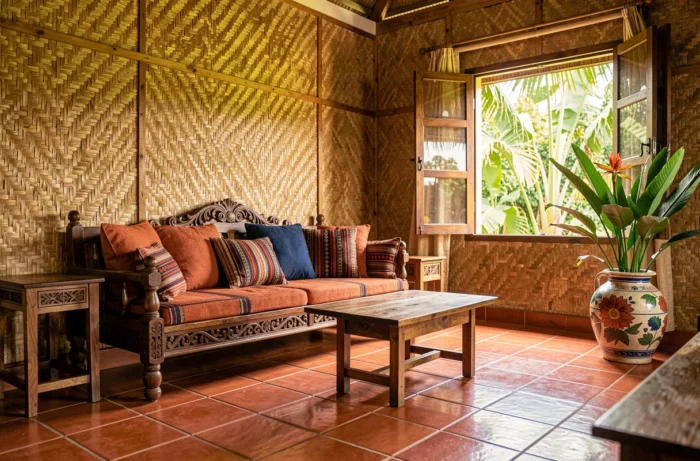
- For the living room, pairing a terracotta wall with rosewood furniture creates a warm contrast without overcrowding the space
- In the kitchen, a solid local wood countertop (rosewood or treated eucalyptus) withstands temperature variations better than imported laminate
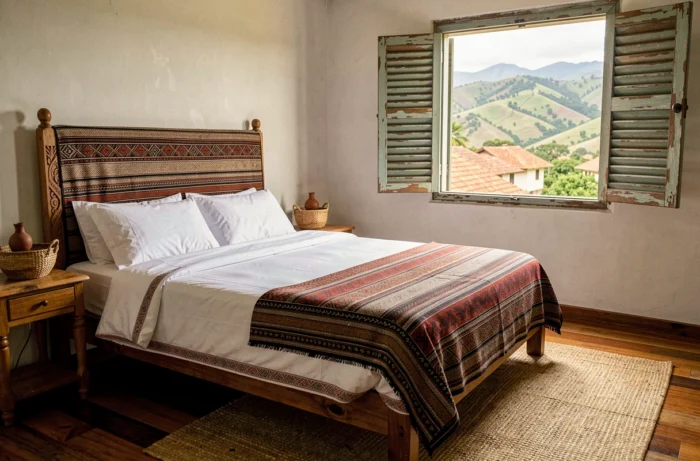
- Bedrooms gain visual freshness with landibe silk textiles in natural tones (beige, ivory) set against a sage green wall
Linen and cotton, combined with raffia for accessories, complete this approach without resorting to synthetic materials ill-suited to the climate.
Natural ventilation and layout of living spaces
Interior decoration in Madagascar cannot ignore a physical constraint: the management of heat and humidity dictates the choice of materials and the arrangement of furniture. A poorly thought-out layout can transform a carefully decorated interior into an uncomfortable space.
Design principles for a ventilated interior
Placing heavy furniture (bookshelves, cabinets) against the walls least exposed to sunlight frees up areas near openings. Curtains made of wild silk or lightweight cotton allow air circulation, unlike thick fabrics like velvet.
Woven sisal rugs are a better alternative to carpets, which retain moisture and encourage dust mites in a tropical climate. Sisal absorbs little water and dries quickly.
For the kitchen and bathroom, local granite (available in several regions) offers a heat-resistant and easy-to-clean surface. Malagasy granite costs significantly less than imported granite for equivalent performance.
Tropical garden decoration: extending the interior to the exterior
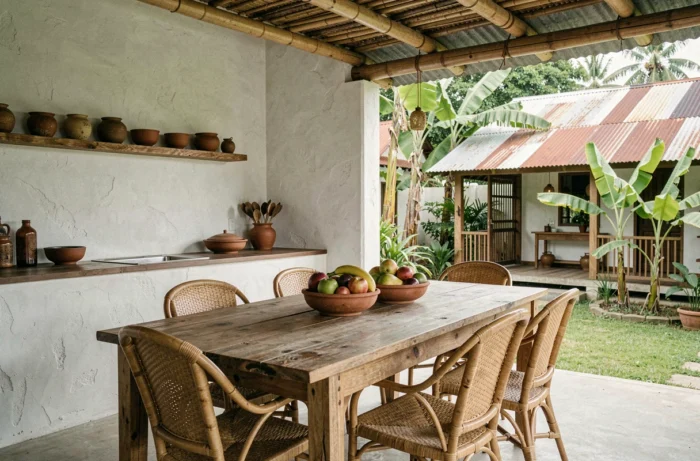
In Madagascar, the boundary between indoors and outdoors is porous. Many houses have a varangue (covered veranda) that serves as the main living space for much of the year.
Designing this intermediate space requires materials that withstand the elements while maintaining a neat appearance. Furniture made of woven raffia on a metal frame holds up better than untreated rattan, which warps in the rain.
- Sisal plant pots for tropical plants (ravenala, tree ferns) visually structure the varangue
- Lighting with fixtures made of Antemoro paper, protected under the roof overhang, provides soft light in the evening
- Thick cotton cushions with local patterns (lamba prints) personalize the space without investing in new furniture
A well-designed varangue becomes the most used room in the house. It filters light, ventilates naturally, and connects the garden to the living room.
The design of a house in Madagascar is based on a simple principle: local materials, chosen based on their region of origin and resistance to the climate, often outperform imported alternatives in both durability and aesthetic coherence. Antemoro paper from Ambalavao, marquetry from Ambositra, or sisal from the South serve both technical and decorative functions.