Riding a motorcycle as a woman is not just a matter of style or posture. It’s primarily about preparation, technical choices, and long-term comfort. General advice often revolves around the license or the look, but female riders embarking on adventures on two wheels need more concrete answers, tailored to their body shape and travel constraints.
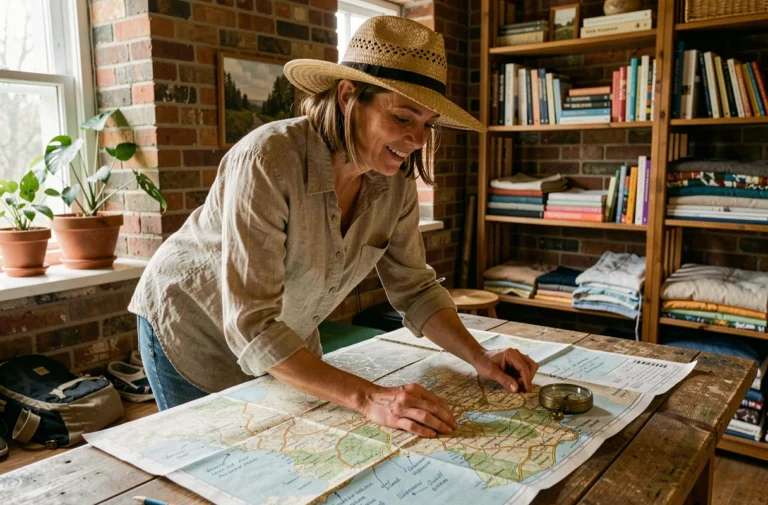
Preparing a motorcycle route when riding alone
Have you ever noticed that most motorcycle travel guides never mention riding times? For a woman traveling alone, the choice of time slot radically changes the experience.
European indicators on public space safety show that women feel significantly less safe than men at night, with more than ten percentage points difference in many areas. Applied to motorcycling, this feeling naturally leads to early morning departures and arrivals before dark.
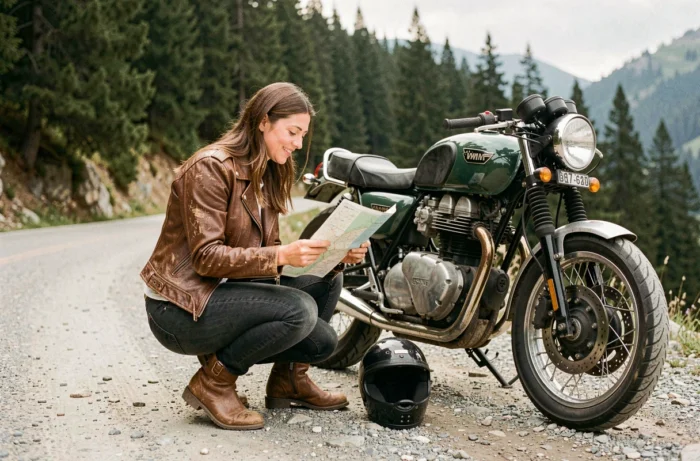
Planning stages based on daylight is not a whim. It’s a strategy that allows for calm route selection, avoiding poorly lit areas, and finding accommodation without stress. Female rider communities regularly share their routes and feedback, especially on missdeuxroues.fr, which helps identify reliable stops before setting off.
Favoring well-frequented secondary roads rather than deserted national roads is also part of the habits to adopt. A slightly longer route that passes through villages offers refueling points, assistance in case of breakdown, and a more enjoyable ride.
Women’s motorcycle gear: what really matters for travel
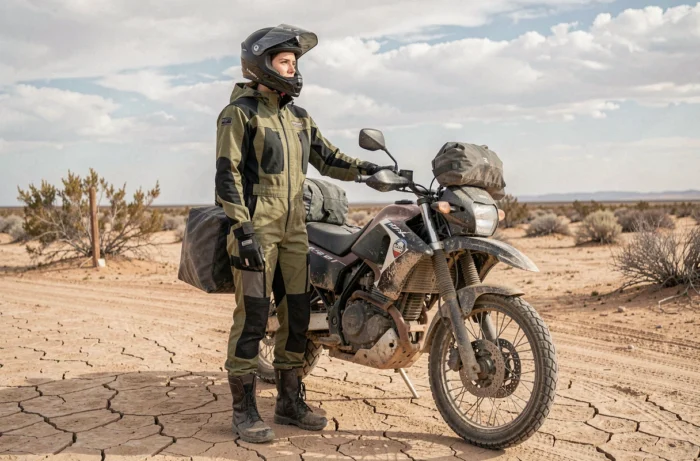
The market for women’s motorcycle gear has evolved significantly in recent years. Manufacturers now incorporate lighter materials, enhanced protections, and more durable fabrics designed for female riders on long journeys.
Why this shift? Because female riders who travel for several days have different needs than a twenty-minute urban ride. A jacket that’s too heavy tires the shoulders. Poorly cut pants compress the hips after three hours. Tailored cuts exist, but the cut alone does not guarantee long-term comfort.
Criteria to check before buying
- Adjustable ventilation: on a summer trip, a jacket without vents becomes a sauna. Look for openings on the chest and back, with zippers easy to operate with gloves
- The total weight of the outfit (jacket, pants, boots, gloves): overly heavy gear adds invisible fatigue that shows on long stages
- Certified back and joint protections: they should be integrated or easily addable, not sold separately as an option
- Rain resistance: an integrated waterproof membrane prevents having to put on overpants by the roadside in the rain
Connected features are also making their way into standard gear. Some airbag vests include sensors that trigger inflation in case of a fall. This type of protection, once marginal a few years ago, is becoming accessible at reasonable budgets and deserves consideration for long trips.
Choosing a motorcycle suited for adventure and body shape
The choice of motorcycle dictates everything else. A bike that’s too tall or too heavy turns every stop into a balancing act.
Why is seat height the primary criterion? Because having both feet flat on the ground changes confidence at startup and stop. On a trail or a roadster, a few centimeters make the difference between a calm break and a fall while stopped on a gravel parking lot.
Used motorcycles: points to inspect
Buying a used motorcycle remains the best way to access a quality model without breaking the bank. Before signing, check the condition of the tires, chain tension, brake pad level, and maintenance history.
A often overlooked point: the rear suspension. On a used model, it may have been adjusted for a rider of a very different size. Adjusting the spring preload to one’s own weight immediately improves the motorcycle’s handling in corners and on rough roads.
Women’s motorcycle helmet: selection and adjustment for long distances
The helmet is the most personal piece of gear. A poorly fitting helmet causes headaches after an hour of riding and pressure points on the temples or forehead.
The shape of the skull varies from person to person, and so-called “women’s” models do not always differ in their internal shape. What matters:
- Try the helmet for at least ten minutes in-store, chin strap closed, to identify compression areas
- Check that the inner foams are removable and washable, a practical detail after several days of travel
- Choose an anti-fog visor or one compatible with a pinlock, especially for early morning departures in the mountains
A modular helmet may seem practical, but it is generally heavier than a classic full-face helmet. For touring use, a lightweight full-face helmet with good sound insulation remains the best compromise.
Female motorcycle adventure is built on concrete choices: a thoughtful itinerary, tested gear before departure, a motorcycle adjusted to one’s body shape. Mastering each technical detail frees up mental space to enjoy the road.