
You have just adopted a cat found by a neighbor, or a friend has entrusted you with their dog because they can no longer keep it. The animal is microchipped, vaccinated, and in good health. Everything seems settled. Except that, in the eyes of the administration, it still belongs to its former owner. As long as the change of ownership is not registered, you are not recognized as the legal guardian of the animal.
Holder or owner: a distinction that changes everything on I-CAD
The national I-CAD database, managed under the authority of the Ministry of Agriculture, records two types of information for each identified animal: the owner (the one who holds the legal title) and the holder (the person who cares for the animal on a daily basis). In most cases, it is the same person. But in the case of a donation, sale, or adoption, these two statuses temporarily dissociate.
Why does this distinction matter? Because the owner registered on I-CAD remains civilly responsible for the animal, including any damages it may cause. In practical terms, if a dog bites someone while you are housing it without having completed the process, it is the former owner who will be contacted, and potentially held liable.
Before starting any procedure, it is essential to understand that changing the name of the owner in the national database is not a secondary administrative formality: it is what officially transfers responsibility.
Inheritance and separation: two cases where the transfer becomes complicated
Online guides detail the steps to follow for a standard sale or donation. However, two situations remain poorly documented: the death of the owner and the separation of a couple.
Inherited animal after a death
When an owner passes away, their animal is part of the estate just like any other movable property. An heir who decides to keep, sell, or give away the animal is making a pure and simple acceptance of the inheritance. In other words, they can no longer refuse the inheritance afterward.
If there are multiple heirs, the animal is in joint ownership. Changing the holder on I-CAD then requires an agreement among all heirs, or, in case of disagreement, a decision from the judicial court. A simple visit to the veterinarian is not sufficient to resolve this legal issue.
Divorce or separation
French law does not provide any mechanism for shared custody of a pet. Despite the recognition of the animal as a “living being endowed with sensitivity” in the Civil Code, the division of an animal in the event of separation falls under property law. One of the spouses obtains ownership, and that person must be listed on I-CAD.
In practice, the family court judge can assign the animal to one party or the other, taking into account the animal’s best interest, but no “shared custody” has any legally binding value. The newly designated owner must then make the change in the national database.
Transfer declaration on I-CAD: the step-by-step online procedure
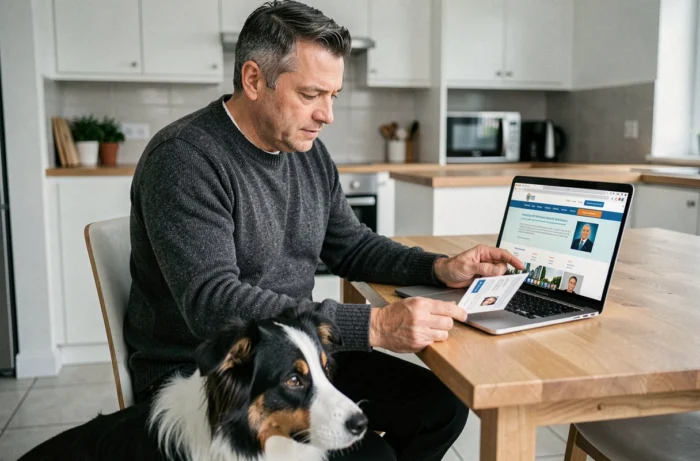
It is the former owner (the transferor) who initiates the process. Here is the concrete procedure on the holder’s space of the I-CAD website.
- Log in to your holder space on i-cad.fr and access the section “Change the holder of your animal”.
- Provide the complete contact details of the new holder (name, address, phone, email).
- Validate the form: the new holder then receives an email or SMS to confirm and finalize the transfer.
- An identification card in the name of the new owner is generated after confirmation.
The online process is free and almost instantaneous. The former owner does not need to visit a veterinarian for this sole formality.
If the transferor does not initiate the process
This is the most common point of friction. You have taken in an animal, but the former owner is unresponsive or refuses to start the procedure. I-CAD provides for a derogatory procedure: the new owner can request the change themselves, but they will need to provide additional documentation (transfer certificate, veterinary certificate, proof of the animal’s handover).
If there is no response from the former holder within the allotted time, I-CAD can validate the transfer based on the documents provided. Therefore, keeping the transfer certificate signed by both parties is a precaution not to be overlooked.
Mandatory documents when transferring a dog or cat
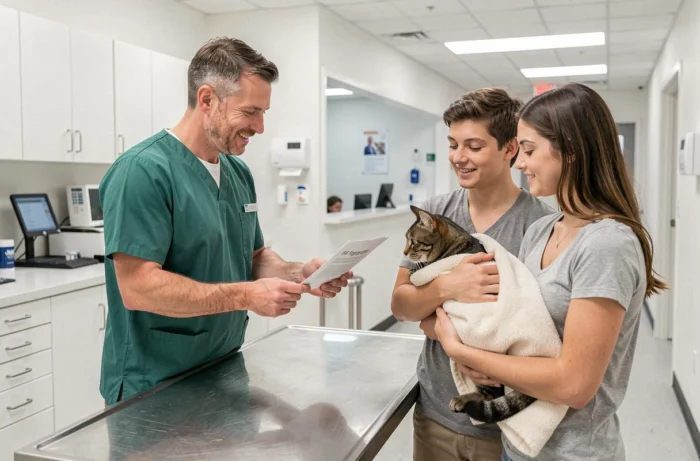
Even before touching the I-CAD database, transferring an identified animal requires gathering several documents. Their absence can delay or even block the transfer.
- The transfer certificate (Cerfa form or free document), signed by the transferor and the acquirer, mentioning the date, the identification of the animal, and the contact details of both parties.
- The veterinary certificate of good health, issued by a professional in the days preceding the transfer.
- The health booklet or European passport of the animal, with the vaccination history.
- The information document on the needs and characteristics of the animal, mandatory for dogs and cats.
For category 1 or 2 dogs, additional documents are required (behavioral assessment, ownership permit). The veterinarian who issues the certificate of good health can verify that the file is complete.
Common mistakes that block the change of ownership
You may have noticed that some administrative procedures seem simple on paper, but then get stuck over a detail? The transfer of ownership of a pet is no exception to this rule.
The most common mistake is believing that the purchase or donation is enough to transfer ownership. Without a declaration on I-CAD, the animal remains attached to its former owner, even years after the transfer. In case of loss, it is the former owner who will be contacted, not you.
Another pitfall: an unidentifiable animal (neither microchipped nor tattooed). Identification is a legal obligation for dogs, cats, and ferrets. If the animal you are taking in is not identified, the first step is to visit the veterinarian for the insertion of a microchip before any change declaration.
Finally, failing to update your own contact details on I-CAD after a move renders the entire system useless. The national database only serves its purpose if the information it contains is accurate and current.
The rigor of these procedures protects both the animal and its new owner. A complete file, a transfer recorded on I-CAD, and up-to-date contact information ensure that the animal can be found in case of escape, and that civil liability rests on the right person.