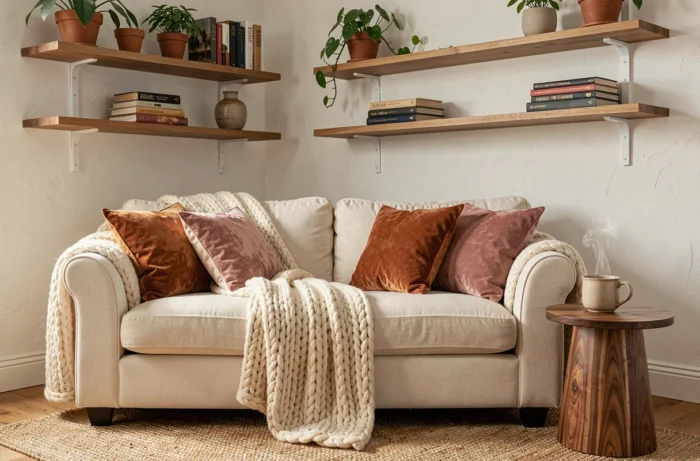
Transforming a house into a comfortable cocoon relies less on the accumulation of decorative objects than on a few measurable parameters: perceived temperature, quality of light, and acoustic absorption of materials. Starting April 1, 2024, the mandatory energy audit for homes classified E, F, or G sets a hygrometric comfort goal between 18 and 20 °C all year round. This official threshold reminds us that the true cocoon begins with the building envelope, long before the choice of a throw.
Thermal performance and perceived comfort: what audits really measure
Most cocooning decor guides overlook a structural fact: the sensation of comfort depends as much on the temperature of the walls as on that of the ambient air. A poorly insulated wall at 14 °C in a room heated to 21 °C produces a perceived temperature significantly lower than what the thermostat indicates.
The first scenario of the energy audit requires a gain of at least two energy performance classes and work on at least two insulation points. The RE2020, applicable to new constructions, adds an indicator of degree-hours of discomfort for summer comfort, combining insulation, thermal inertia, natural ventilation, and solar protections.
Before investing in decoration, a simple diagnosis allows for prioritizing needs. The resources available on Veridictus’s home page detail several of these technical criteria applied to housing.
| Parameter | Impact on comfort | Main lever |
|---|---|---|
| Wall temperature | Changes the perceived temperature by several degrees | Interior or exterior insulation |
| Humidity | Air too dry or too humid, skin and respiratory discomfort | Mechanical ventilation, natural ventilation |
| Summer comfort (overheating) | Difficult nights, chronic fatigue | Solar protections, inertia, air circulators |
| Acoustic absorption | Reduction of stress, feeling of enclosure | Thick textiles, heavy curtains, high-density rugs |

Light and cocooning ambiance: layering light rather than using a ceiling fixture
A single ceiling fixture emits cold, uniform light that flattens the space. To create an enveloping atmosphere, the strategy is to layer multiple light sources at different heights.
Three levels of light are sufficient in a room: indirect lighting high up (LED strip behind a shelf), a reading lamp at mid-height, and a source at floor level or coffee table height. Each layer can be adjusted independently, allowing for the ambiance to be tailored to the time of day.
- A dimmer on each source allows for reducing intensity in the evening without multiplying switches
- Light bulbs with a color temperature below 2,700 kelvins reproduce the warm hue of a candle, without the drawbacks of combustion
- Adjustable fixtures (wall sconces, articulated arm lamps) create intentional shadow areas that enhance the cocoon effect
Visual comfort in a bedroom or relaxation space also involves eliminating distracting sources: standby device indicators, bright screens, blinds that let in urban lighting. A blackout curtain paired with a light sheer addresses both issues by modulating natural light during the day and blocking light pollution at night.
Materials and acoustics: the role of textiles in a room’s comfort
Textiles are not just decorative. A long-pile rug absorbs impact noise, a thick curtain dampens sound reverberation, and a dense cushion alters how sound travels in the room. In a home with smooth walls and hard floors, the reverberation time can double, which tires the ear without us being aware of it.
Layering textures remains the most effective way to dampen ambient noise while enhancing the cocoon sensation. A rug under the coffee table, a throw on the sofa seat, cushions of varying weights on the bed: each textile layer adds an acoustic barrier.
Choosing materials according to the room
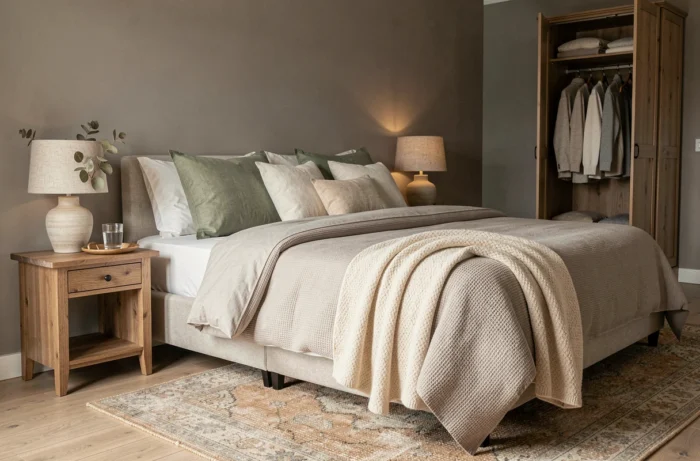
In a bedroom, natural fibers (washed linen, brushed cotton) regulate humidity better than polyester, contributing to nighttime hygrometric comfort. In a living room, corduroy or boucle wool are more durable while maintaining their softness.
The color of materials also plays a measurable role. Neutral and matte shades (beige, terracotta, warm gray) absorb light instead of reflecting it, reducing visual fatigue at the end of the day. A palette of three to four similar tones avoids monotony without creating harsh contrast.
Summer comfort: transforming the cocoon without overheating
The notion of a cocoon house is often associated with winter, but the RE2020 has made summer comfort a regulatory issue. The ceilings of degree-hours of discomfort vary according to climate zone and altitude, which requires thinking about comfort over twelve months.
In summer, the same textiles that warm the atmosphere in winter can become a trap. A few seasonal adjustments are sufficient:
- Replace the thick duvet cover with a linen sheet, which is more breathable and thermoregulating
- Swap heavy curtains for cotton sheers that filter sunlight without blocking cross-ventilation
- Install external solar protections (awnings, adjustable slats shutters) to reduce heat gain before it reaches the window
Summer comfort relies on nighttime ventilation and solar protections, much more than on air conditioning. A well-insulated and properly ventilated house retains its interior freshness for several hours after outdoor temperatures rise.
The comfortable cocoon is not just a matter of decoration. The temperature of the walls, the quality of lighting, the acoustic absorption of textiles, and the management of summer comfort form a coherent whole. Acting on these four parameters produces a more lasting result than a simple accumulation of accessories, regardless of the season.