
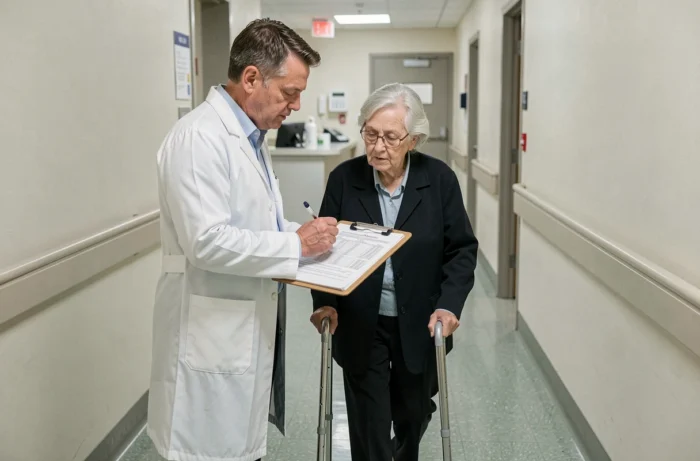
A patient gets up from a chair, takes a few steps, and sits back down. The evaluator checks boxes on a printed grid. The score is in: 22 out of 28. Moderate risk of falling. But does this score really reflect the patient’s ability, or the conditions under which the test was conducted?
The Tinetti test, designed by Mary Tinetti in 1986, remains a widely used clinical tool for measuring balance and gait in older adults. Its 16 items rated on 28 points allow for stratification of fall risk. The grid appears simple. It is precisely this apparent simplicity that generates reproducible scoring errors from one evaluator to another.
Reliability of the Tinetti score: what the PDF grid does not correct
A printed grid freezes the items and titles. It does not freeze the way each evaluator observes, times, or interprets a movement. Two professionals facing the same patient can arrive at different scores of several points.
The problem does not come from the grid itself, but from what it leaves implicit. For example, the item “standing balance with eyes closed” does not always specify the expected observation duration. An evaluator who waits three seconds and another who waits ten are not measuring the same thing.
Before using the printable Tinetti test, it is essential to understand that the PDF document is a data collection tool, not a complete administration protocol. The oral instructions given to the patient, the height of the chair, the type of floor: all of this affects the result without appearing on the sheet.
Scoring static balance: three tricky items
The balance section of the Tinetti test accounts for 16 points out of 28. This is often where scoring discrepancies are most pronounced.
Chair rise
The item asks to score the patient’s ability to stand up. Have you ever noticed that a patient who uses the armrests does not get up the same way depending on the height of the seat? A chair that is too low skews the evaluation of the rise. The test should be conducted on a standard height chair, without armrests, unless the patient usually uses an aid.
Scoring “gets up with the help of arms” when the chair is abnormally low assigns the patient a deficit that belongs to the furniture.
Balance after a sternum push
This item evaluates the patient’s reaction to a light push on the sternum. The difficulty: the intensity of the push is not standardized. If it is too light, it tests nothing. If it is too strong, it causes a loss of balance even in a stable subject.
The practical recommendation is to apply a brief pressure, with an open palm, sufficient to cause a slight backward movement of the trunk. But this instruction remains subjective.
360-degree pivot
The patient must turn around. The scoring distinguishes continuous steps from discontinuous steps. In practice, many patients slow down mid-turn without really stopping. The evaluator hesitates between 1 and 2 points. This gray area generates systematic variations.
Administration errors in the walking section of the Tinetti test
The walking section consists of 7 items for 12 points. The most frequent errors concern the walking distance and the position of the evaluator.
- Course too short: some PDF versions do not specify the length of the course. A three-meter corridor does not allow for observing step regularity or trajectory. A minimum of eight meters is necessary for the walking to stabilize.
- Evaluator positioned too close: walking just behind the patient alters their behavior. The patient speeds up or stiffens. Observation should be done slightly back and to the side to avoid interference.
- Technical aid removed: the test is conducted with the patient’s usual aid (cane, walker). Removing the aid to “see the true level” skews the score and exposes the patient to a real risk of falling during the evaluation.
The height and length of the step are judged visually, which requires training. A novice evaluator may tend to overestimate the step length in a shorter patient, simply because the step/leg ratio appears correct.
Interpretation of the Tinetti score and fall risk thresholds
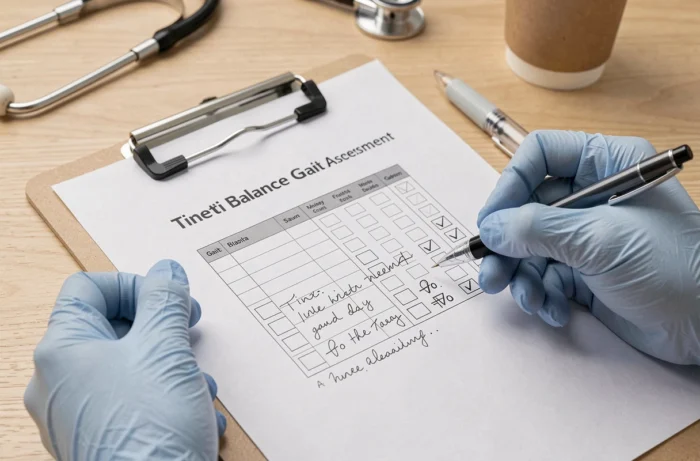
The classic thresholds are known: above 24 points, the fall risk is considered low. Between 19 and 24, the risk is moderate. Below 19, it is high.
These thresholds provide an indication, not a diagnosis. An isolated score is not sufficient to predict a fall. Recent clinical syntheses show that patients classified as high risk by this type of tool are identified with good specificity but moderate sensitivity. In other words, a low score signals a real problem, but a correct score does not guarantee the absence of risk.
This is why current recommendations integrate the Tinetti into a multifactorial approach to fall prevention. The assessment of gait and balance is combined with a review of medications, screening for orthostatic hypotension, and a cognitive examination.
- A patient on psychotropic medication with a score of 23 does not have the same risk profile as a patient without treatment at the same score.
- A fear of falling reported by the patient alters their performance on the test without reflecting an objective motor deficit.
- A score that drops by 3 points between two evaluations spaced six months apart is more informative than a single score.
Longitudinal follow-up of the Tinetti score provides more than the raw number. The same patient evaluated regularly, under the same conditions, by the same professional: it is this consistency that makes the tool reliable.
The printed grid remains a good starting point. It does not replace the rigor of administration or the clinical reasoning that transforms a number into a decision tailored to the patient.