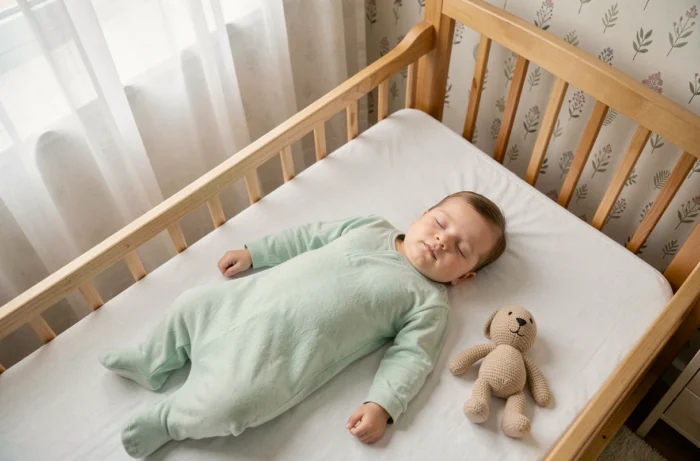
The sleeping bag is the first recommended sleeping equipment for an infant in France. Health authorities, notably the HAS and Assurance Maladie (Ameli), have been reminding since 2024 that safe sleeping relies on a strict principle: baby on their back, in a sleeping bag suitable for their size, without any blanket, duvet, or bumper, in a room kept between 18 and 20 °C. Choosing the right sleeping bag is therefore as much about safety as it is about comfort.
Sleeping bag and heatwave: a blind spot in classic guides
Most content on the subject assumes that the baby’s room remains within the ideal range of 18 to 20 °C. Increasingly frequent heatwaves seriously complicate this assumption.
French public recommendations now specify that beyond 27-28 °C in the room, the sleeping bag should no longer be used. A light bodysuit or a simple diaper is sufficient for the night. This temperature threshold is rarely mentioned by brands, which focus on TOG ratings without addressing the scenario of very hot nights.
During periods of extreme heat, opting for a sleeping bag with a very low TOG (0.5) remains relevant as long as the room temperature does not exceed this critical threshold. Beyond that, removing the sleeping bag becomes the only response in line with safety recommendations. Parents looking for lightweight sleeping bags suitable for summer can consult the references available on bullabebe.com, which offers several models in fine cotton.
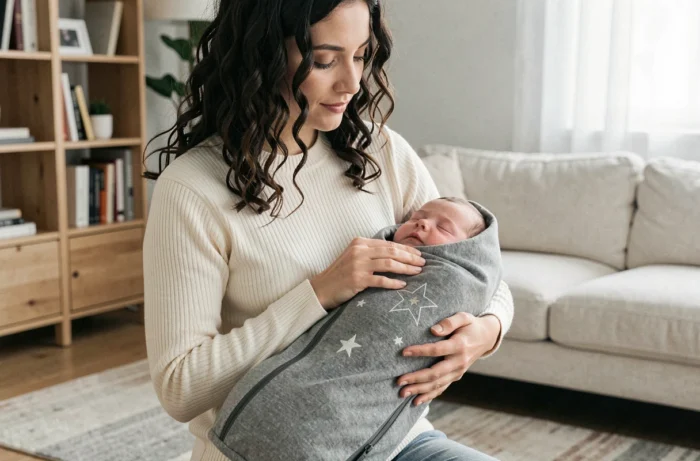
TOG of the sleeping bag: what this number indicates (and does not indicate)
TOG measures the thermal resistance of the fabric. The higher it is, the more the sleeping bag retains the baby’s body heat. This rating system allows for matching the thickness of the bedding to the ambient temperature of the room.
TOG correspondence and room temperature
| Room Temperature | Recommended TOG | Underwear |
|---|---|---|
| Above 27 °C | No sleeping bag | Diaper or light bodysuit |
| 24-27 °C | 0.5 | Short-sleeved bodysuit |
| 21-23 °C | 1 | Long-sleeved bodysuit |
| 18-20 °C | 2 to 2.5 | Pajamas + bodysuit |
| Below 18 °C | 2.5 to 3 | Pajamas + long-sleeved bodysuit |
This table serves as a guideline, not an absolute rule. The back of the baby’s neck remains the best indicator: if it is damp, the child is too hot, regardless of the displayed TOG. Cold extremities (hands, feet) are not a reliable sign of cold in infants.
Field reports vary on the actual usefulness of TOG 3. Some manufacturers market them for unheated rooms, but French public recommendations do not go beyond TOG 2.5. A TOG that is too high increases the risk of overheating, a recognized factor in the prevention of sudden infant death syndrome.
Size of the sleeping bag and safety: the risk of an oversized sleeping bag
An oversized sleeping bag poses a real danger. If the fabric rises above the shoulders, the baby’s head can end up inside the sleeping bag, creating a suffocation risk. Conversely, a sleeping bag that is too tight restricts movement and disrupts sleep.
Standard sizes generally break down as follows:
- Birth to 6 months: 0-6 month sleeping bag, suitable for babies measuring up to about 67 cm
- 6 to 18 months: intermediate size, for children who are starting to roll over on their own
- 18 to 36 months: large size, often the last before transitioning to a duvet
The right guideline: the armholes should be snug without being constricting. The baby should not be able to slip inside the bag through the arm openings. The closure systems play a role in this adjustment. Shoulder snaps allow for finer adjustments than side zippers, but the latter facilitate nighttime changes.
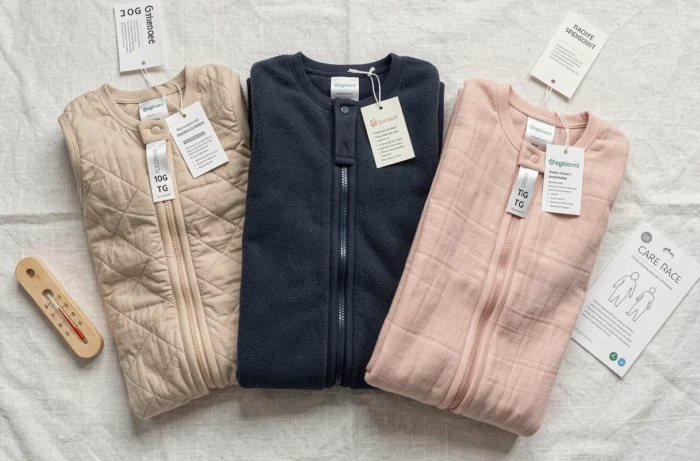
Material of the sleeping bag: cotton, muslin, or fleece
Cotton remains the reference material for the majority of sleeping bags. Breathable and washable at high temperatures, it is suitable for almost all seasons. Cotton muslin, lighter and more airy, is particularly suitable for warm months.
Fleece or wadding is used as filling or lining in high TOG models. They provide warmth but do not wick moisture as well as cotton. For an infant who sweats a lot, a cotton model with a sufficient TOG will often be more comfortable than a fleece sleeping bag.
Oeko-Tex or GOTS labels guarantee the absence of harmful substances in the textile. This criterion deserves attention: a newborn’s skin is in prolonged contact with the fabric throughout the night.
When to stop using the sleeping bag
The INSERM study published in 2020 documents a reduction in the risk of sudden infant death syndrome associated with the use of the sleeping bag. This benefit justifies its prolonged use, generally until 18 or 24 months depending on the child’s mobility.
The signal for transitioning to a duvet is the child’s ability to cover and uncover themselves independently. As long as this action is not mastered, the sleeping bag remains the safest option. Some children continue to use it beyond 2 years without issue, especially if they sleep restlessly and consistently uncover themselves at night.
The complete absence of any covering over the sleeping bag remains the rule until this age, even in winter. This point, reaffirmed by French health authorities in 2024, constitutes one of the fundamentals of safe sleeping that every parent should know before choosing any bedding accessory for their child.