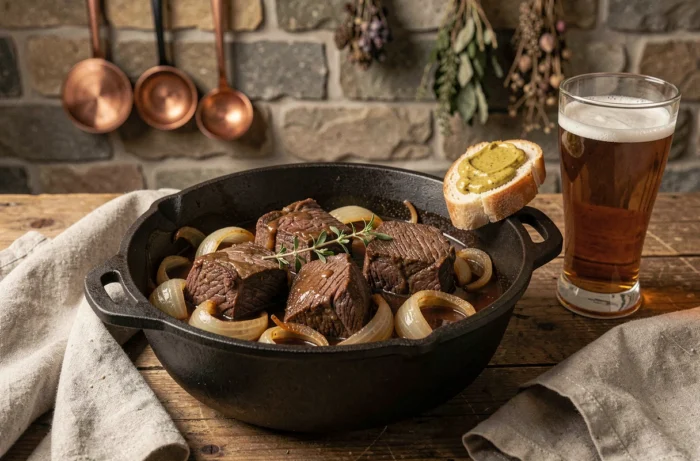
Flemish carbonade and beef bourguignon share the same principle of slow cooking in a pot, but their flavor profiles diverge from the choice of braising liquid. Understanding what separates them technically allows for a decision based on the desired taste outcome.
Braising Liquid and Maillard Reaction: Brown Beer vs. Red Wine
The Flemish carbonade relies on a brown or amber beer as the braising base. The residual sugars in the beer caramelize upon contact with the browned meat and onions, producing Maillard compounds different from those obtained with a tannic wine. The result is a thick, slightly sweet-bitter sauce, dominated by malt.
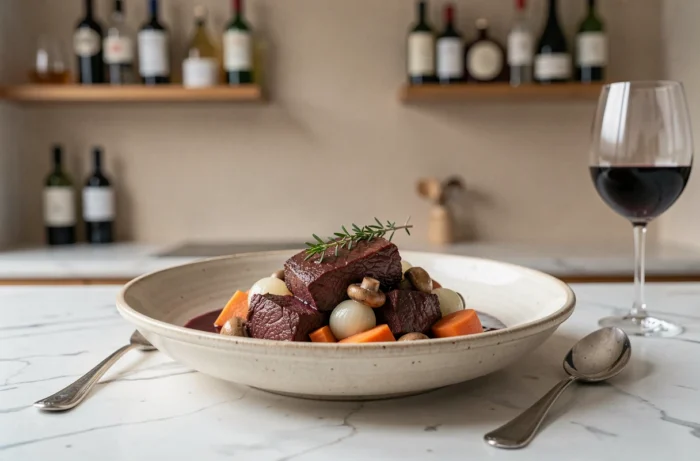
Beef bourguignon uses a full-bodied red wine, often a Burgundy or a Côtes-du-Rhône. The acidity of the wine tenderizes the collagen fibers of the chuck or the shank, while the tannins provide a structuring bitterness. The final sauce leans towards deep wine notes, with a residual acidity that beer does not produce.
We observe that this difference in liquid conditions everything else: choice of aromatics, cooking time, suitable cuts of beef. Opposing these two dishes amounts to comparing two philosophies of braising, which constitutes a duel of flavors in the kitchen where every technical variable matters.
Beef Cuts and Preparation: Chuck, Brisket, or Shank
Both recipes require cuts rich in collagen to withstand prolonged braising, but regional preferences differ.
For Flemish carbonade, we recommend chuck or flank cut into thick slices. Flemish tradition favors flattened pieces, arranged in alternating layers with sliced onions and slices of bread spread with mustard. This layered arrangement promotes an even penetration of beer into the meat.
Beef bourguignon tolerates a wider variety of cuts: brisket, shank, beef cheek. The cutting is done into cubes of four to five centimeters. This different geometry exposes more surface area to the Maillard reaction during the initial browning and allows for even cooking in the wine.
The choice of cut directly influences the final texture. A chuck in carbonade yields a melting and flaky result. A beef cheek in bourguignon produces a gelatinous, almost confit texture. Both are excellent, but not interchangeable without adjusting the cooking time.
Aromatics and Condiments: Mustard, Gingerbread, and Bouquet Garni
The Flemish carbonade is distinguished by two elements absent from the bourguignon: mustard and gingerbread (or speculoos in some Belgian versions). The mustard, spread on slices of bread placed on the meat, acts as a natural binder and thickener while adding a kick. The spices in the bread (cinnamon, nutmeg, clove) merge with the malt of the beer during simmering.
Bourguignon relies on a classic bouquet garni (thyme, bay leaf, parsley), smoked lardons, and an aromatic garnish of pearl onions, carrots, and button mushrooms. Flour is used during browning to coat the meat and thicken the sauce.
- Carbonade: strong mustard, gingerbread or brown sugar, caramelized onions, brown beer, sometimes a splash of cider vinegar to balance the sweetness
- Bourguignon: lardons, bouquet garni, red wine, mushrooms, pearl onions, flour for the roux
- Common point: both dishes require a veal stock or gelatinous broth to enhance the texture of the sauce
The carbonade plays on the sweet-bitter register, while the bourguignon plays on the acid-umami register. This opposition explains why the accompaniments differ: fries for the former, steamed potatoes or fresh pasta for the latter.
Cooking Time in the Pot and Temperature Management
Both dishes simmer for a long time, but not in the same way.
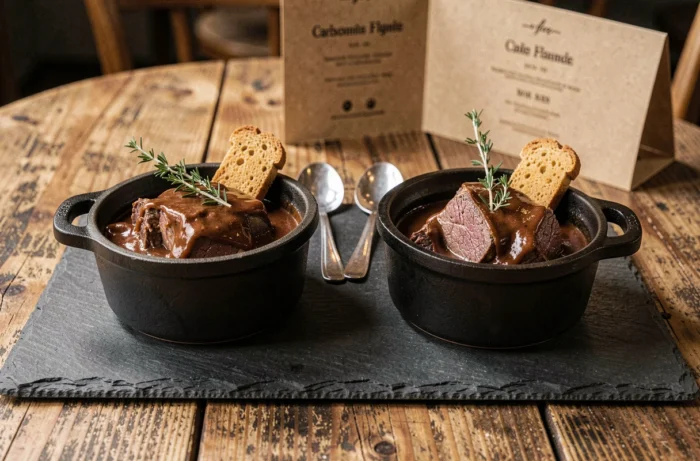
The Flemish carbonade is traditionally cooked in the oven at 150 to 160 °C for two to three hours. The layer of mustard-coated bread forms a crust on the surface that protects the meat from drying out. We observe that this oven cooking, rather than low heat on the stovetop, produces an enveloping heat that is better suited to the layered arrangement.
Beef bourguignon is conducted over very low heat on the stovetop or in the oven at a similar temperature. The gradual reduction of the wine concentrates the flavors. A bourguignon prepared the day before and reheated gains depth, as the collagen fibers continue to transform into gelatin during cooling.
Both dishes improve when reheated the next day. The carbonade gains in sauce homogeneity, while the bourguignon benefits from the melding of tannins.
Flemish Carbonade in Breweries: A Competitive Dish
The carbonade is not confined to a purely domestic register. In Belgium, it is the subject of competitions in breweries, such as the BXLOVE competition in Brussels, where establishments compete with their version of the dish. The Grand Café in Brussels placed sixth in 2024 with a carbonade made with Leffe brown beer, offered at 22 euros on its menu in early 2025.
This premium positioning in restaurants contrasts with the sometimes reductive image of a cheap family dish. Beef bourguignon enjoys a more established gastronomic prestige in France, supported by Burgundian cuisine and its great names, but the carbonade is gaining visibility outside its regions of origin.
The choice between the two depends less on a hierarchy of quality than on the desired flavor profile. A round, malty sauce with a sweet hint enveloping tender slices of meat: the carbonade wins. A winey sauce, structured by tannins, with a garnish of mushrooms and lardons: the bourguignon remains the reference.
Both require the same care in browning, the same simmering time, and the same patience to achieve the appropriate result.