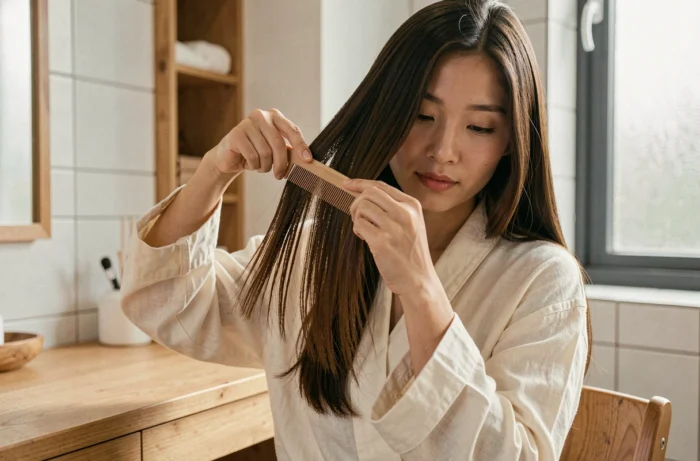
The shape of a hair is determined beneath the skin, in the hair follicle. A round follicle produces straight hair, an oval follicle produces wavy hair, and a flattened follicle produces curly to kinky hair. This geometry, genetically determined, influences how sebum flows along the fiber and the hair’s ability to retain moisture.
Recognizing your hair type thus involves understanding a biological mechanism before choosing any product.
Porosity and thickness: two criteria more reliable than shape alone
Visual classifications (straight, wavy, curly) dominate online hair guides. They are useful for initial orientation, but they are not enough to build an adapted routine. Two complementary parameters radically change the choice of care.
Porosity describes the ability of the cuticle (the outer layer of the hair) to absorb and retain water. Hair with low porosity has tightly packed scales: it resists hydration but retains it for a long time once penetrated. Hair with high porosity, often weakened by coloring or repeated straightening, absorbs water quickly but loses it just as fast.
To assess porosity, the water glass test remains the simplest method: a clean hair strand placed on the surface that sinks in a few seconds indicates high porosity. A hair that floats for a long time signals low porosity. This parameter directly guides the choice of care textures (heavy oils for high porosity, light mists for low).
The individual thickness of the strand is tested by rolling a hair between the thumb and index finger. A fine hair is barely perceptible to the touch. This data is as important as shape, because a fine and curly hair does not tolerate the same active ingredients as a thick and curly hair.
To delve deeper into these distinctions and accurately identify your hair profile, Beauté Chic’s hair tips detail each category with concrete benchmarks.

Straight, wavy, and curly hair: what each structure really requires
Rather than making a list of products by type, it is more useful to understand the underlying mechanism that makes each hair fiber vulnerable to a specific problem.
Straight hair and excess sebum
Straight hair offers a flat surface on which sebum glides unobstructed from root to tip. As a result, the roots appear greasy within one to two days, while the tips remain relatively protected. The challenge is not to strip the scalp but to regulate lipid production without damaging the skin barrier.
Gentle sulfate-free surfactants are better suited for straight hair prone to oiliness than clarifying shampoos used too frequently, which cause a rebound effect of sebum. Rinsing with lukewarm water (not hot) also limits stimulation of the sebaceous glands.
Wavy hair and loss of definition
The wave forms a loose S that easily unravels under the weight of overly rich products or due to mechanical brushing. The cuticle is semi-open, placing this type in an intermediate zone: porous enough to absorb a light treatment, not enough to withstand thick butters.
Air drying while scrunching the strands upwards preserves the natural wave better than any styling product. Light gels made from aloe vera or flaxseed provide hold without weighing down the fiber.
Curly to kinky hair and chronic dehydration
The tighter the spiral, the more open the cuticle, and the harder it is for sebum to travel down the fiber. Curly to kinky hair is thus structurally predisposed to dryness. Breakage occurs mainly at the twist points of the curl, where the fiber is the thinnest.
- Moisturize before nourishing: apply a water or glycerin-based leave-in on damp hair, then seal with a vegetable oil (avocado, castor) to limit evaporation.
- Detangle only on wet hair soaked in conditioner, starting from the tips, using a wide-tooth comb or fingers.
- Protect at night with a satin pillowcase or a silk bonnet to reduce friction that lifts the cuticle scales.
Field reports vary on the ideal washing frequency for this hair type. Some hairdressers recommend one shampoo per week, while others space it out to ten days. The frequency depends on the scalp, not on the length or shape of the curl.
European regulation on silicones: what changes in hair formulas
Cyclic silicones (D4, D5, D6) are present in many serums and masks designed for dry or curly hair. They provide a smooth feel and shine. The Regulation (EU) 2024/1328 of May 16, 2024 modifies Annex XVII of REACH and prohibits the marketing of substances containing these siloxanes at a concentration equal to or greater than 0.1% by weight, with an effective date set for June 6, 2026.
This restriction forces brands to reformulate their ranges. Emerging alternatives (plant esters, light substitute oils) do not always offer the same level of coating. For curly hair with high porosity, accustomed to heavily siliconed treatments, the transition may temporarily cause an increased feeling of dryness.
The available data does not yet allow for conclusions about the long-term effectiveness of substitutes compared to traditional silicones. The first reformulations that have hit the market show different textures, sometimes more aqueous, which change the usual application methods.
Adapting your routine according to the season and the actual state of the hair
The same hair can change behavior from one season to another. Ambient humidity in summer swells the cuticle of wavy and curly hair, accentuating frizz. Heating in winter dries out the scalp of all types, including straight hair.
- Reassess porosity twice a year, as chemical treatments and sun exposure alter it.
- Adjust the richness of care: lighter textures in spring, denser as winter approaches.
- Space out heat sources (hair dryer, straightener) when the hair shows signs of fatigue, such as split ends or loss of elasticity.
Hair type is a starting point, not a fixed label. Regularly observing how your fiber reacts to products and environmental conditions remains the only way to maintain a truly effective routine.